
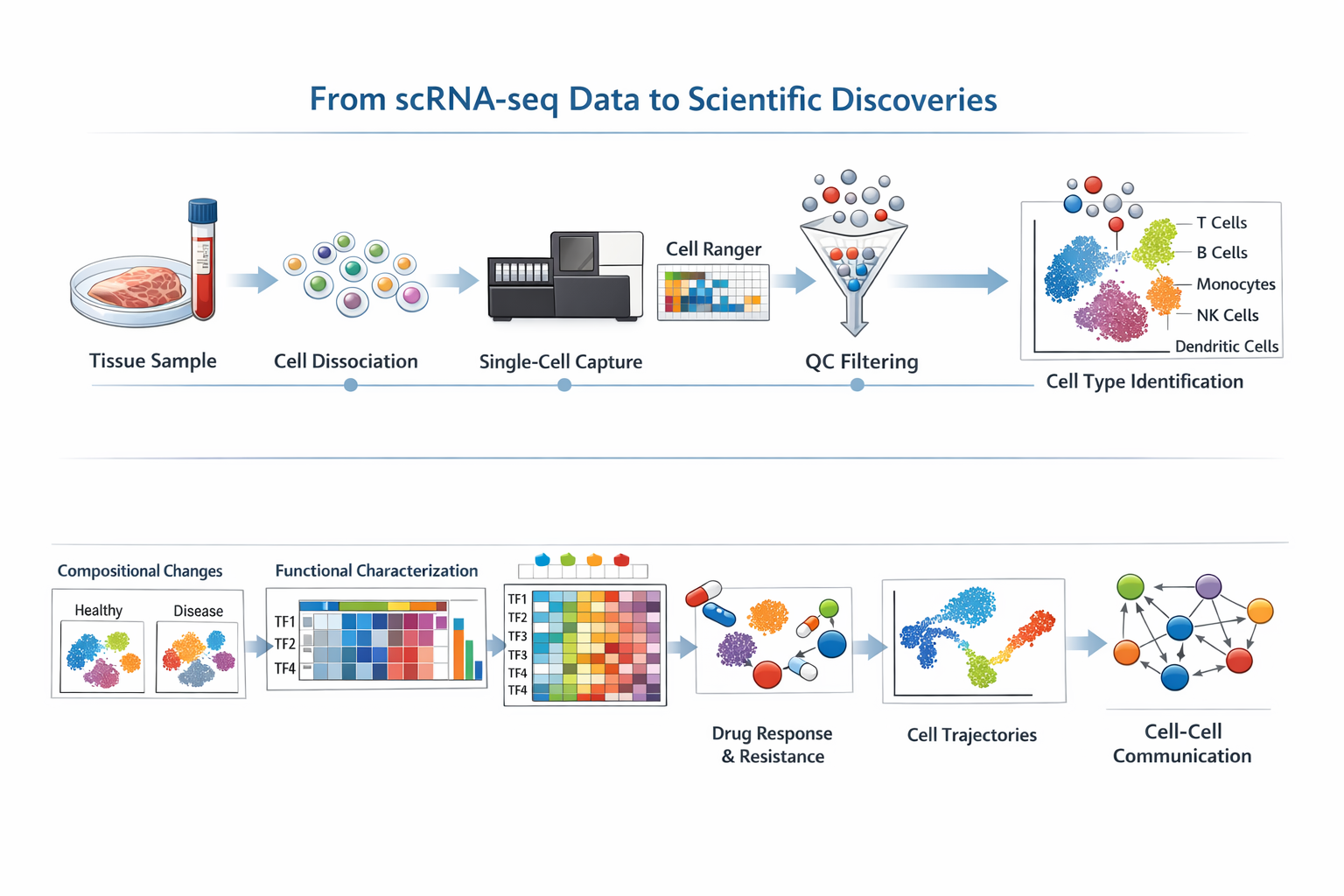
1 Introduction: The revolution of seeing cells as individuals
1.1 Every cell tells a different story
For over a century, biology has studied tissues as collectives. When we extract RNA from a tumor biopsy, a blood draw, or a brain region, we measure the average gene expression of millions of cells. This approach, known as bulk RNA sequencing, has been enormously productive: it has identified disease signatures, revealed pathway dysregulation, and guided therapeutic development across oncology, immunology, and neuroscience.
But averaging hides heterogeneity. Consider a tumor: it is not a uniform mass of identical cancer cells. It contains malignant cells in different proliferative states, immune cells attempting to mount a response, stromal cells providing structural support, and endothelial cells forming blood vessels. A bulk measurement blends all of these signals into a single profile, making it impossible to determine which genes are active in which cells, or how these populations interact.
Single-cell RNA sequencing (scRNA-seq) removes that limitation. By measuring the transcriptome of each individual cell, scRNA-seq reveals the full diversity of cell types and states within a sample, providing a level of resolution that fundamentally changes the questions we can ask.
1.2 What makes single-cell different?
The conceptual shift from bulk to single-cell is not merely a matter of higher resolution. It opens entirely new categories of biological inquiry:
1.2.1 Discovering cell types you didn’t know existed
Every tissue that has been profiled at single-cell resolution has revealed unexpected complexity. The human lung was thought to contain roughly 10 cell types; single-cell atlases have identified over 50 distinct populations, including rare progenitor cells and transitional states that had never been characterized [1]. In the immune system, scRNA-seq has uncovered previously unknown subtypes of dendritic cells [2], tissue-resident memory T cells [3], and innate lymphoid cells [4] that play critical roles in disease but are invisible to bulk analysis.
These discoveries are not academic curiosities; they have direct translational implications. A rare cell population representing 2% of a tumor may be the one driving drug resistance, but it will never appear in a bulk expression profile.
1.2.2 Understanding cellular heterogeneity within a “single” cell type
Even cells that share the same identity marker can exist in remarkably different functional states. CD8+ T cells in a tumor microenvironment, for example, range from fully activated effector cells to deeply exhausted populations that have lost their cytotoxic capacity [5]. These states are defined by continuous gradients of gene expression, not discrete boundaries, and they can only be resolved at single-cell level.
This matters for precision medicine. Two patients whose tumors look identical by bulk RNA profiling may have very different immune landscapes at the single-cell level, explaining why one responds to immunotherapy and the other does not.
1.2.3 Tracing how cells change over time
Cells are not static. They differentiate, activate, age, and respond to signals from their environment. scRNA-seq can capture snapshots of these dynamic processes and computationally reconstruct the trajectories that cells follow as they transition between states.
In developmental biology, this has enabled researchers to map the complete sequence of cell fate decisions during embryogenesis, from a single fertilized egg to the hundreds of specialized cell types in the adult body [6]. In disease, trajectory analysis reveals how healthy cells progressively acquire pathological features, identifying the molecular events that drive the transition from normal tissue to disease. A striking example comes from the tumor microenvironment: Delgado et al. (2022) applied single-cell RNA-seq to normal and malignant breast tissue to reconstruct how healthy stromal cells become cancer-associated fibroblasts (CAFs), showing that resident fibroblasts and pericytes converge on three evolutionarily conserved CAF subtypes (matrix, chemokine, and contractile) through a transitory JUN+ activation state, and pinpointing the signaling cues (TGF-β, PDGF, TNF, and NOTCH ligands) that educate normal stroma into a tumor-supportive phenotype [7].
1.2.4 Mapping cell-cell communication
No cell exists in isolation. Cells constantly communicate through secreted signals, surface receptors, and direct physical contact. scRNA-seq provides the data needed to computationally infer these cell-cell communication networks by identifying which cells express specific ligands and which express the corresponding receptors [8, 9].
This is particularly powerful in complex tissues like tumors, where understanding the crosstalk between cancer cells, immune cells, and the stromal microenvironment can reveal why certain tumors evade immune surveillance and identify new therapeutic targets.
1.3 Why now? The technology has matured
The first single-cell transcriptome was sequenced in 2009, measuring gene expression in a single mouse blastomere [10]. That pioneering experiment was technically demanding, expensive, and limited to individual cells processed one at a time.
Today, the landscape is radically different:
- Throughput: Modern platforms like 10x Genomics Chromium [11] routinely capture 10,000–50,000 cells per experiment, with some approaches scaling to millions of cells.
- Cost: The cost per cell has dropped from hundreds of dollars to cents, making large-scale studies financially accessible [12].
- Reproducibility: Standardized protocols, commercial kits, and automated microfluidics have made scRNA-seq experiments highly reproducible across laboratories.
- Computational tools: A mature ecosystem of open-source analysis software (Seurat [13], Scanpy [14], and many specialized tools) provides robust, well-validated pipelines for data processing and interpretation.
- Reference atlases: Large-scale initiatives like the Human Cell Atlas [15], Tabula Sapiens [16], and CZ CELLxGENE [17] have generated comprehensive reference datasets that enable rapid annotation of new experiments by comparison to curated maps of cell diversity.
The technology is no longer experimental, it is a standard tool in the modern biological research toolkit.
1.4 What questions can scRNA-seq answer for your research?
Regardless of your specific field, scRNA-seq can address fundamental questions that are difficult or impossible to answer with bulk approaches:
| Research question | What scRNA-seq provides |
|---|---|
| What cell types are present in my tissue? | Unbiased identification and quantification of all cell populations, including rare types |
| How does disease alter cellular composition? | Comparison of cell type proportions and states between conditions (healthy vs. disease, treated vs. untreated) |
| Which cells are driving a phenotype? | Identification of the specific cell population responsible for a disease signature or treatment response |
| What genes define each cell population? | Marker gene discovery for each cell type, enabling targeted follow-up experiments |
| How do cells communicate in my tissue? | Inference of ligand-receptor interactions and signaling networks between cell populations |
| How do cells change during a process? | Reconstruction of differentiation, activation, or disease progression trajectories |
| Why do patients respond differently to treatment? | Resolution of patient-specific cellular heterogeneity that explains differential outcomes |
| What is the immune landscape of my tumor? | Comprehensive profiling of tumor-infiltrating immune cells, their activation states, and exhaustion levels |
1.5 How this guide is organized
This guide is designed to show you the full potential of single-cell analysis, selecting the best published examples to illustrate how scRNA-seq answers real scientific questions. Along the way, we highlight the key considerations and pitfalls that can make or break a single-cell experiment.
By the end of this guide, you will understand:
- How to design a single-cell experiment and choose the right technology for your question.
- What factors influence data quality and how to avoid common pitfalls.
- How to interpret the key visualizations and results produced by a single-cell analysis.
- What biological insights can be extracted and how to plan follow-up experiments.
Whether you are considering your first single-cell experiment, interpreting results from a collaboration, or evaluating whether scRNA-seq is the right approach for your research question, this guide will give you the foundation you need to make informed decisions.